
I’m sitting on the terrace of the Dan Boutique Hotel, enjoying a cup of hot coffee and savoring the air of a crisp winter evening in Jerusalem, when I notice a half dozen washers and dryers in an alcove at the back of the patio. It seems an odd place to put laundry machines: most hotels do their sheets and towels out of sight of the guests. The washers and dryers are also far smaller than the commercial machines used by such establishments. My next thought is they must be for guests, but they lack coin slots. Does this hotel really offer free laundry to lodgers?
When I ask at the front desk, I learn they’re not for guests, or more accurately, for guests like me. The Dan Boutique, like many other hotels in central and southern Israel, has housed northern residents displaced by months of shelling and rocket fire. Paid for by the government, thousands of Israelis have been living in hotels for a year or more. At the Dan Boutique, almost 30% of the guests are displaced families. The free washers and dryers are exclusively for their use.
Ever since childhood I’ve loved staying in hotels. Hotel stays meant vacations, tons of TV channels, cool toiletries, and someone else to make your bed. But imagine if circumstances compelled you to live in a hotel for more than a year without a kitchen or most of your belongings? The novelty of a hotel stay would lose its charm quickly. If the current ceasefire with Hezbollah holds, perhaps these folks will be able to go home. From my conversations with them, their impatience to get back to their lives is obvious.
The next morning, I drive to Tel Aviv to visit Hostage Square. Located in front of the Tel Aviv Museum of Art, the square is about the size of a square block. Although the plaza has accommodated as many as 120,000 people at once, there are only two dozen or so individuals wandering among the various sculptures and art installations expressing the pain and fear of the captives and their families.
In the back of the square is a 25-meter-long faux tunnel, a reminder of the subterranean hellholes in which the terrorists have imprisoned the hostages. Inside the names of the kidnapped are written on the walls; gunshot sounds are periodically broadcast through a speaker to underscore the peril the captives face.
At the center of the plaza sits a yellow piano, donated by the family of Alon Ohel, a 24-year-old musician imprisoned in Gaza. Passersby are invited to play it – Alon’s mother believes that in some profoundly spiritual way Alon and his fellow hostages can feel the music reassuring them they aren’t alone. Indeed, perched atop the instrument is a sign which reads, “You Are Not Alone”. Earlier this year, musicians played identical pianos in cities around the world — including Berlin, Paris, New York, and Pittsburgh — to honor the captives.
When I first arrive, a young man is soulfully playing the piano. When he leaves, I sit down on the bench. I’d like to play, but the only song I know on a keyboard is “Mary Had a Little Lamb,” and it feels sacrilegious to play something so silly. Instead, I sit quietly in silence and send the music of hopeful thoughts toward Gaza.
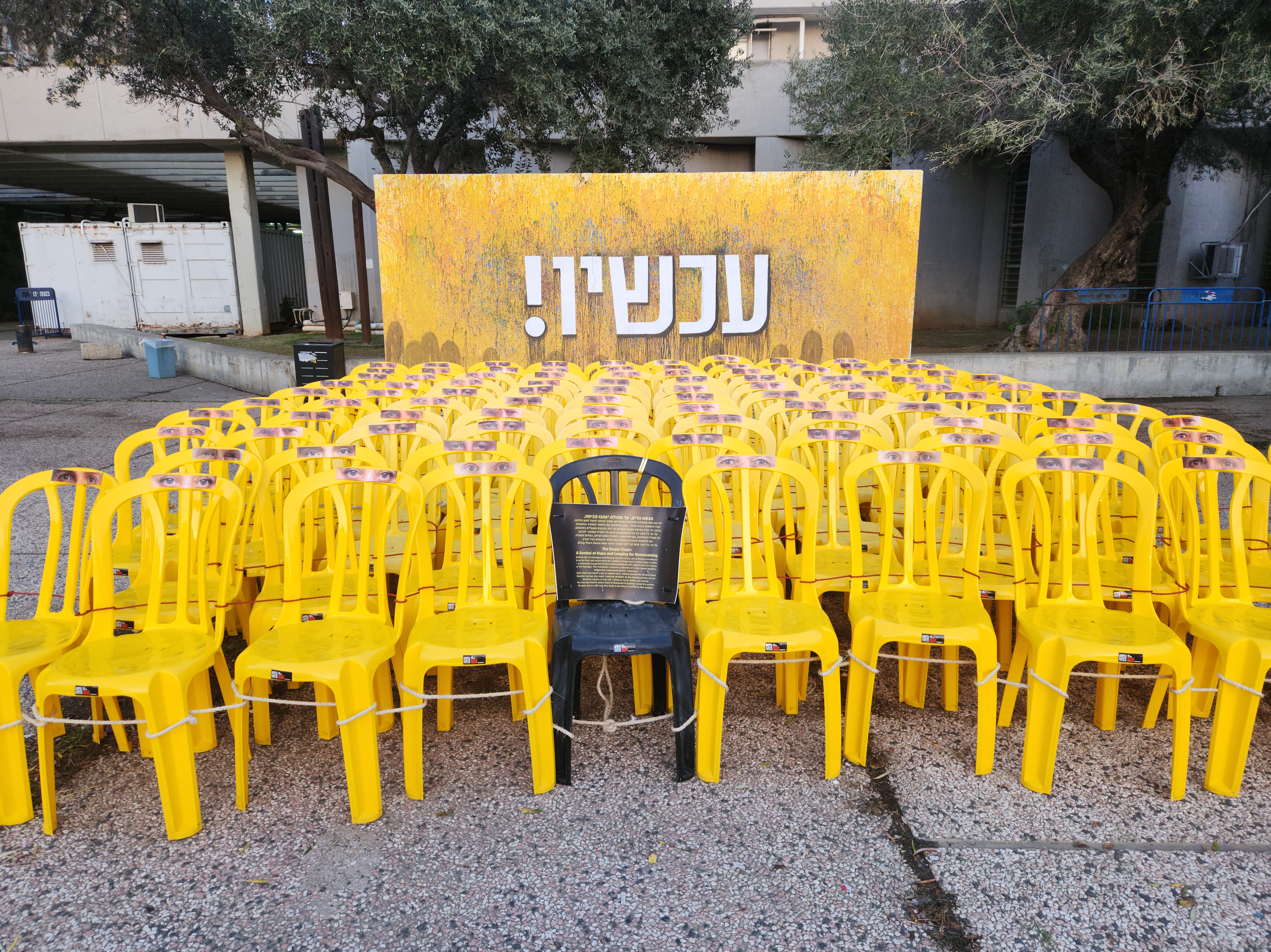
Along the side of the plaza is an installation of yellow chairs chained together. On each is a rectangular sticker with a pair of eyes staring back at the viewer — accusingly? with anguish? It’s impossible to know.
The empty chairs remind me of Kiseh Eliyahu, the Chair of Elijah, on which it is customary to place a baby boy before his bris. In First Kings, Elijah experiences an overwhelming sense of loneliness and isolation. Believing he is God’s sole surviving prophet, he complains to the Almighty that Israel has abandoned God’s covenant (I Kings 19:10). According to rabbinic tradition, the Eternal decrees that Elijah must forever after attend every brit milah to bear witness to Israel’s fulfillment of its covenant with God. Elijah is also the herald of the Messianic age in Jewish thought – was the invisible prophet sitting on one of those yellow chairs? Or were the empty chairs a lament of abandonment as poignant as Elijah’s? Were we able to bring the hostages home would the Messiah then come? The answers remain as hidden as Elijah’s whereabouts.
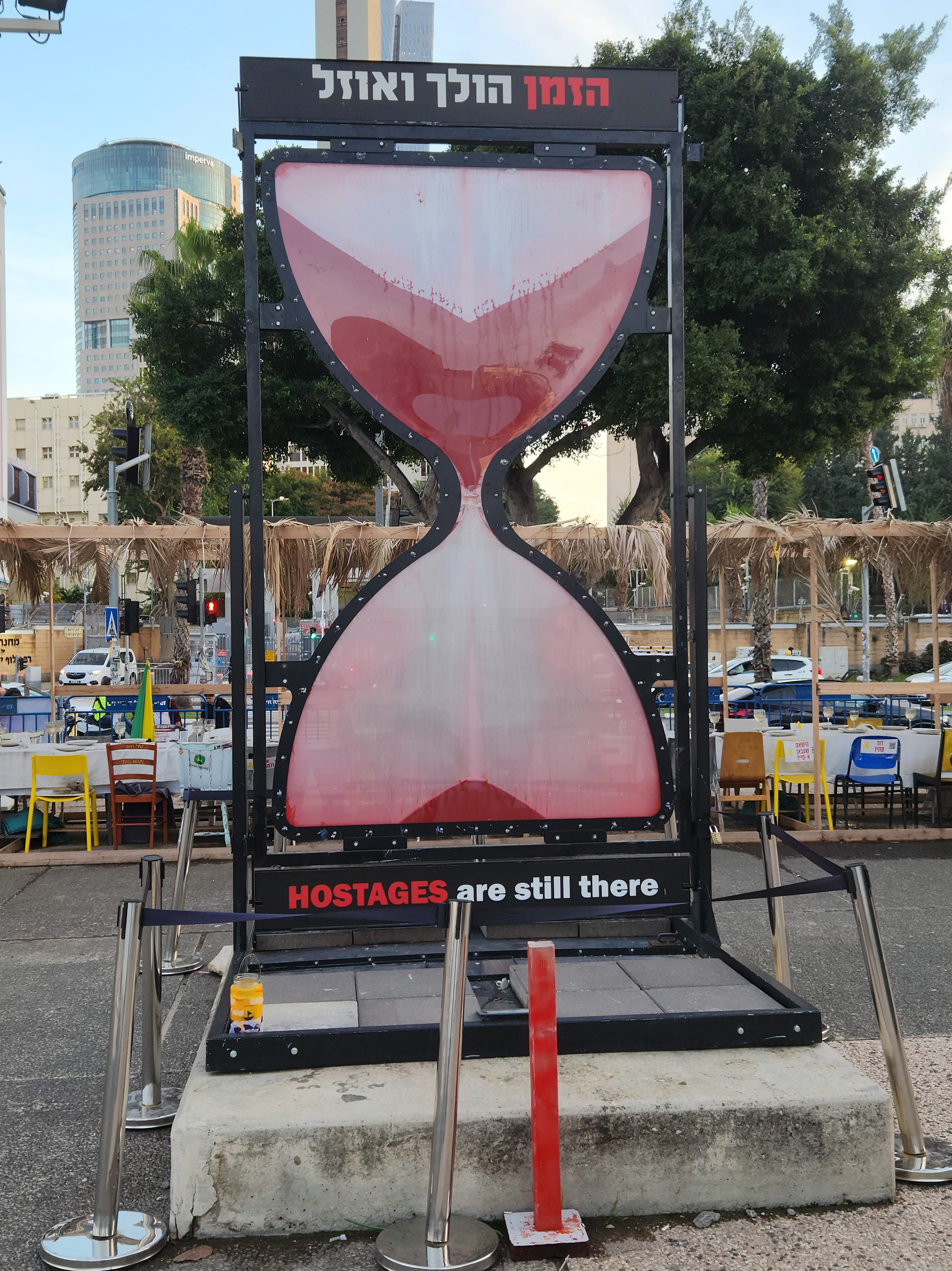
Near the empty chairs is a huge electronic clock tracking the days, hours, minutes, and seconds since the hostages were taken to Gaza; it relentlessly measures the duration of captivity in ever increasing increments. What we really need, however is a countdown clock. There is no way to know, of course, how much time the hostages have left before they are murdered by Hamas terrorists, or die of neglect, illness, or even from the friendly fire of Israeli forces. But surely time is running out. A large picture of an hourglass positioned elsewhere in the square reminds one of this terrible, yet incontrovertible, truth.
In Israel I see relatively few people wearing yellow ribbons. This is not surprising. If you think about it, the entire country is a big yellow ribbon. The photos of the hostages are everywhere. Banners are hung from highway overpasses and on streetlights. They read: “What if it were YOUR child?”; “Forgive us for not bringing you home”; or “Save them from hell”. Other signs express dismay with the government, calling for a non-partisan commission to formally investigate responsibility for the colossal security failures of October 7th or castigating the ultra-Orthodox who refuse to serve in the IDF during this time of war. A huge billboard over the Ayalon Freeway in downtown Tel Aviv features a photo of a scowling Donald Trump with an English message: “End this F***ing War Now!” Underneath the President-Elect’s picture appears the caption “Make Israel Normal Again”. The plaintive message communicates anger and angst.
As darkness falls, I leave Hostage Square and head back to Jerusalem. As my car climbs through the Judean Hills on Highway 1, I see the city lights shimmer in the distance, beckoning and welcoming me back to Jerusalem. What the hostages would give to see those lights growing brighter around every upward curve of the highway! They are just 76 kilometers . . . and a galaxy away. Tonight will be my last night in Israel. I pray it will not be theirs.
Jonathan Lubliner
Jack F. Shorstein Senior Rabbi




 Rabbi Jonathan Lubliner